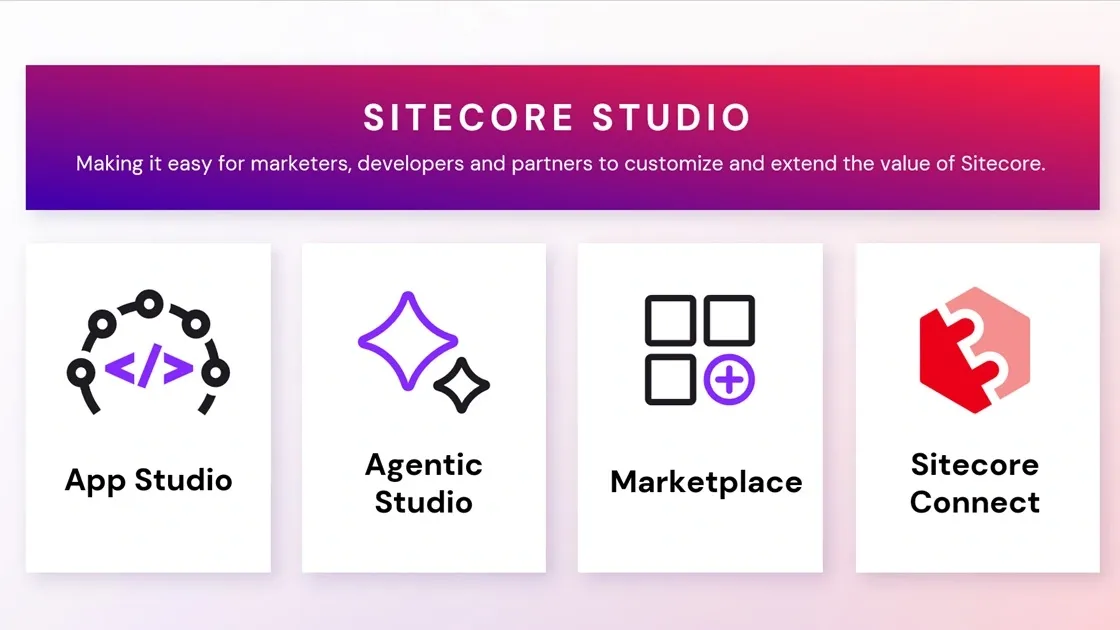
At Symposium 2025, Sitecore announced Sitecore Studio. The press releases talk about innovation layers, agentic workflows, and the end of the SaaS-versus-flexibility trade-off. The community is reacting to it as a product launch.
It is not really a product launch. It is something more interesting, and the strategic story is worth telling honestly.
As a three-time Sitecore MVP who has been working with this platform for nearly two decades, here is my read on what Studio actually represents, where Sitecore is going with it, and what is not being said clearly enough.
Studio is mostly a narrative, and that is not a criticism
Three of the four pillars existed before. App Studio, Marketplace, and Sitecore Connect were all available capabilities, just spread across different product pages and partner documentation. Only Agentic Studio is genuinely new.
What Studio does is bundle a fragmented extensibility story into a single, coherent narrative. That sounds like marketing, and it is, but it is also strategically important. Sitecore has historically struggled to sell extensibility to enterprise procurement because the story required walking buyers through six product pages. Studio solves that problem in a single conversation.
This is good positioning. But buyers and partners should be clear about what is new technology and what is repackaging.
The real strategic shift was SitecoreAI, not Studio
Studio only makes sense in the context of the SitecoreAI consolidation. Before that consolidation, Sitecore had CMS, DAM, MRM, CMP, and CDP as separate products with separate extension models. Building a unified Studio layer across that fragmentation was technically impossible.
SitecoreAI changed that. By unifying the product suite onto a single Azure-based platform with a shared data model, governance framework, and security model, Sitecore created the foundation for everything that came after. Studio is the visible layer on top of that foundation.
If you want to understand where Sitecore is going, focus on the consolidation. Studio is the consequence, not the cause.
Sitecore is making the Salesforce play, ten years late
What Sitecore is actually building with SitecoreAI plus Studio plus Marketplace is the same architectural pattern Salesforce built with the Sales Cloud, AppExchange, and Trailhead over the past 15 years. Unified core platform, partner-driven extension marketplace, developer enablement layer, governed customization framework.
This is the right architectural direction for an enterprise software vendor in 2026. It is also a direction Adobe took with Experience Manager and Adobe Exchange, and Salesforce took with the Customer 360 suite. Sitecore is not innovating the model. It is adopting it.
The question is whether the catch-up can succeed against vendors who have a decade head start on Marketplace ecosystem quality and developer mindshare. The answer depends almost entirely on whether the Marketplace gets to critical mass within the next 18 months.
The XM Cloud rebrand is a real risk
XM Cloud was three years into building market recognition. Significant marketing investment, hundreds of customer references, partner certifications, training materials. All of that just became outdated, because the product is now called SitecoreAI.
This is a deliberate trade-off. Sitecore decided that the marketing power of AI was worth the cost of throwing away XM Cloud brand equity. That is a defensible choice in 2026. But every existing customer reference deck needs updating, every partner sales motion needs retraining, and every prospect who heard about XM Cloud last year now has to be told that product no longer exists as a brand.
The message to the market is: this product is fluid. That is not necessarily wrong, but it is a position that competitors will use.
The Agentic Studio bet is against the composable movement
This is the strategic position that deserves the most attention, because it is genuinely consequential.
For the past five years, the dominant narrative in enterprise DXP has been composable. Best-of-breed point solutions stitched together through APIs, giving organizations the freedom to choose the best tool for each capability. Contentful, Commercetools, Algolia, and Builder.io all bet on this direction. Many enterprise buyers followed.
Sitecore Studio is the bet against that narrative. The implicit argument is: composable sounds good until you have to orchestrate multi-step AI agent workflows across five different vendor APIs, each with its own governance model, security context, and data structure. At that point, a unified platform where every agent has native access to content, data, personalization, and DAM in one governed context is structurally better.
This bet is not unreasonable. Composable has real complexity costs that the marketing materials never mention. Organizations that bought composable expecting flexibility often ended up with integration debt instead.
But Sitecore is also betting that the market will move back toward unified platforms in an AI-driven era. If that bet is right, Studio is strategically critical. If the market continues toward composable, Studio is a walled garden in a world that is choosing open architecture.
The Marketplace is the real strategic risk
A marketplace lives or dies on the quality and quantity of its inventory. Sitecore has 550 agency partners and 216 MVPs in its ecosystem, which is a strong starting point.
The question is how many of those partners will invest seriously in building Marketplace products with maintenance commitments, support models, and ongoing investment, rather than treating it as a side project. If the Marketplace has 200-plus actively maintained apps in 18 months, it becomes a genuine strategic asset and a meaningful platform lock-in for customers. If it stalls at 50 underused extensions, it becomes a credibility problem.
This is the metric I will be watching most closely over the next year. It will tell you more about Sitecore’s strategic trajectory than any product announcement.
What Studio does not address
For organizations in the DACH region with serious digital sovereignty requirements, Studio changes nothing about Sitecore’s fundamental dependency profile. SitecoreAI runs on Microsoft Azure. The AI capabilities use Azure OpenAI. Sitecore is a US vendor with US cloud infrastructure.
For most enterprise use cases, that is acceptable. For organizations where sovereignty has become a board-level concern after the Salesforce-Contentful acquisition and the recent US export controls on AI, it is a gap that Studio does not close.
This is not Sitecore’s problem to solve in a single product release. But it is worth noting that the European market is moving in a direction where this question is being asked more loudly than it was two years ago, and Sitecore’s roadmap does not yet have a clear answer.
The honest summary
Sitecore Studio is the most strategically coherent move Sitecore has made in years. Agentic Studio is genuinely new and well-architected. The unified platform direction is correct. The competitive positioning against Optimizely and composable alternatives is materially stronger than it was twelve months ago.
But Studio is mostly the packaging of a deeper strategic bet on platform consolidation in an AI era. Whether that bet pays off depends on execution against three things: Marketplace ecosystem quality, the speed at which existing XP customers migrate to SitecoreAI, and whether the broader enterprise market continues moving toward composable or pivots back toward unified platforms.
The announcement deserves serious attention. It does not yet deserve unconditional enthusiasm. Both can be true.
If you are evaluating SitecoreAI as a platform decision and want a vendor-neutral conversation about what Studio means for your specific roadmap, that is exactly the kind of assessment we do at Diagema.
#SitecoreAI #SitecoreStudio #AgenticAI #DXP #MarTech #SitecoreMVP #DigitalExperience #PlatformStrategy
Ursprünglich veröffentlicht auf LinkedIn.