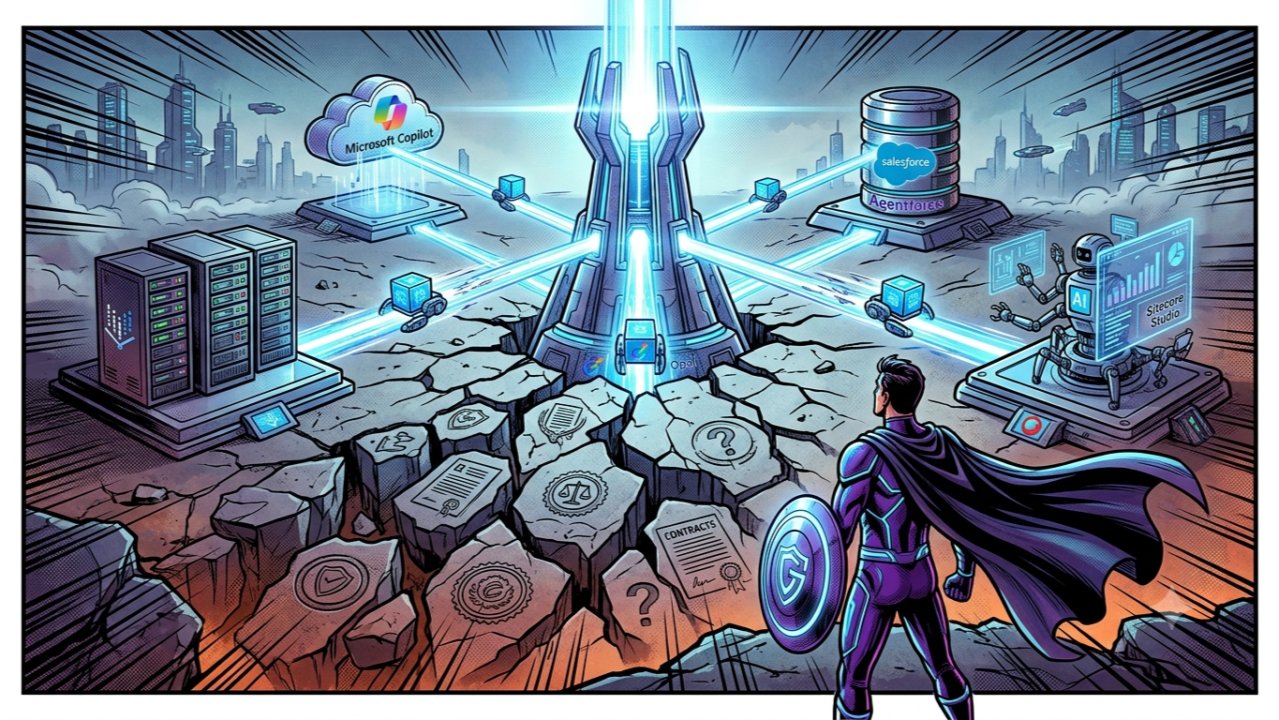
The most consequential gap in enterprise AI right now is not in the technology. It is in the accountability model behind it.
Every major vendor in the enterprise software space is building some version of an agent orchestration capability right now. Microsoft has Copilot Studio. Salesforce has Agentforce. Google has Vertex AI Agent Builder. Sitecore has Agentic Studio. Optimizely has Opal. A growing set of specialized players including LangChain , CrewAI , and AutogenAI are attacking the space from below.
The pitch is remarkably consistent across all of them at a surface level. A coordination layer where AI agents can orchestrate workflows, invoke tools, make decisions, and hand off tasks to other agents.
But there is an important distinction most of the coverage collapses, and it matters for the governance conversation.
Two very different kinds of orchestration
On one side, you have platform-native agent frameworks. Sitecore Agentic Studio and Optimizely Opal are good examples. These orchestrate agents primarily within their own suite. Content generation, personalization, translation, campaign orchestration, all within a governed context the vendor controls end to end. Cross-system integration exists through connectors, but the center of gravity is the platform.
On the other side, you have true cross-vendor orchestration platforms. Microsoft Copilot Studio, Salesforce Agentforce, and Google Vertex AI Agent Builder are the enterprise-scale examples. Specialized frameworks like LangChain and CrewAI are the developer-first examples. These are explicitly designed to orchestrate agents across multiple vendors, systems, and data boundaries.
Both categories are legitimate. Both are being marketed heavily. But they have fundamentally different governance profiles, and that is where the conversation gets interesting.
What governance actually means for AI orchestration
When an AI agent operates inside a single platform, the accountability chain is relatively clean. The vendor is responsible for the model and its behavior within their governed context. The customer is responsible for the prompt and the deployment. The platform provides the audit trail. Legal teams can process this. Insurance markets are starting to price it.
When an orchestration agent invokes a chain of specialized agents across five vendor systems to complete a task, the accountability chain becomes fundamentally different. If the orchestrator makes a bad routing decision, who is liable? If one of the specialized agents produces a compliance violation because it received bad context from the orchestrator, whose fault is that? If the customer’s data flowed through three vendors before the violation occurred, which contract governs the incident?
These are not edge cases. They are the default operating condition for true cross-vendor orchestration architectures.
Why the platform-native side is not off the hook
Platform-native agent frameworks have a cleaner governance story today because the scope is narrower. But that clean story starts fraying as soon as customers do what customers always do, which is push the platform beyond its native boundaries.
An Optimizely Opal agent that pulls in data from an external CRM. A Sitecore Agentic Studio workflow that hands off to a Microsoft Power Automate flow. A native agent that calls an external translation service. Every one of these bridges the governed context and introduces exactly the same accountability questions as full cross-vendor orchestration, just in smaller doses.
The difference is not whether the governance gap exists. The difference is how visible it is to the customer, and how quickly it becomes a business problem.
What the vendors are actually building
Read the marketing materials carefully. The true cross-vendor platforms describe rich orchestration capabilities with impressive breadth. Multi-agent workflows across dozens of systems. Autonomous decision-making within guardrails.
What they describe much less clearly is the accountability model when things go wrong across vendor boundaries. Because they cannot. No single vendor can define the accountability model for a workflow that touches four other vendors‘ systems. That is a legal, contractual, and regulatory problem that is bigger than any product roadmap.
The platform-native side describes narrower orchestration with tighter governance. That story is honest for pure in-platform use cases. It gets less honest the moment customers stretch those boundaries, which they will.
The vendors are building the orchestration technology. They are not building, and cannot build alone, the governance framework that would make the technology safely deployable at true enterprise scale.
Why this matters for platform decisions being made right now
Enterprise organizations are being asked to bet on AI orchestration strategies in 2026 that will not have a mature governance framework until 2028 at the earliest, and possibly not until regulatory pressure forces one into existence.
That gap between capability and accountability is where the actual enterprise risk sits over the next 24 months. Not in the AI models themselves. In the orchestration layer that is being marketed aggressively before the governance framework catches up.
Organizations building serious AI strategies right now should be asking three questions.
First, are you buying platform-native agents or true cross-vendor orchestration? These have different governance profiles and require different frameworks. A one-size-fits-all AI governance policy is inadequate for both.
Second, what does your legal team actually understand about the accountability chain when an AI agent operates across multiple vendor systems? In most organizations, the answer is uncomfortable. Legal is being brought in after the pilot, not before.
Third, what is your organization’s exposure if an autonomous agent operating across vendors produces an outcome that violates your data residency requirements, your brand guidelines, or your customer contracts? And who is responsible for detecting that it happened?
The honest prediction
I think we see three phases play out over the next 24 months.
Phase one, next 12 months: aggressive vendor marketing of orchestration capabilities. Widespread pilot deployments in enterprise organizations. Governance framework treated as an implementation detail.
Phase two, months 12 to 18: the first serious incidents. Customer data flowing through the wrong vendor. Brand violations traced back to cross-system agent workflows. Legal teams discovering that the contractual framework does not cover what actually happened. Media coverage of specific enterprise failures.
Phase three, months 18 to 24: real governance frameworks start to emerge. Cross-vendor accountability standards. Regulatory attention, particularly in Europe. Insurance products that price cross-vendor AI risk. The market slowly stabilizes around a workable accountability model.
The organizations that will navigate this most successfully are the ones that get ahead of it now. Not by avoiding AI orchestration, but by building governance frameworks internally before the market forces one on them.
What this means practically
For CIOs and CDOs evaluating orchestration strategies right now, the practical takeaway is this: the vendor promises are running ahead of the governance reality, and the reality looks different depending on which category of orchestration you are actually buying.
That is not a reason to avoid the direction. It is a reason to build your own governance framework as a first-class part of your AI strategy, not as an afterthought.
At diagema GmbH , this is exactly the conversation we are having with enterprise clients right now. The AI orchestration question is legitimate. The composable-with-external-AI direction is real. The governance layer that would make it safely deployable is your responsibility to build, because no vendor is going to do it for you.
If that conversation is relevant for your organization, now is the right time to have it.
#EnterpriseAI #AIGovernance #AgenticAI #Composable #PlatformStrategy #DXP #DigitalTransformation #SitecoreMVP #diagema
Ursprünglich veröffentlicht auf LinkedIn.