
Last week a PHP zero-day was disclosed, found by an AI-based scanner. By Thursday evening three different people had messaged me a variant of the same take: „see, this is why enterprises should pick Sitecore or Optimizely over open-source stacks.“ I almost replied with the long version. Instead I spent the weekend running a different question past five DXP Trust Centers.
The AI-scanning story does not favour closed source. Microsoft, Google and AWS run internal AI scanners against their own code and have for years. The findings get fixed quietly. The visibility gap between open and closed source is a disclosure-model gap, not a security gap.
What AI-based discovery really changes is the procurement conversation. If scanners now find vulnerabilities in any codebase at scale, the questions a DXP buyer should ask are not about the source model. They are about the vendor’s response machinery.
Five questions. Five vendors. Public documentation only. Where the answer is not public, I say so. A sales rep’s verbal reassurance has no weight in a procurement document, so it does not count here either.
Ground Rules
I checked Trust Centers, HackerOne program listings, CVE databases, Knowledge Base security bulletins, and vendor compliance pages. Where a vendor had an answer in a certification, bulletin or policy that I could cite, it earned a positive mark. Where it did not, I wrote that down. Public documentation is itself an operational security signal, since it is what a procurement team can quote.
I picked Sitecore, Optimizely, Adobe Experience Manager, Contentstack and Storyblok because they turn up in most European enterprise DXP shortlists. The exercise would look different for Acquia, Hygraph or Kentico, and I plan to run it for them next.
The Matrix
Question Sitecore Optimizely Adobe AEM Contentstack Storyblok 1. Patch process documented Yes (triggers, no time SLA) No Monthly cycle plus out-of-cycle No No 2. CVE disclosure process SC-numbered Security Bulletins, Trust Center Security Announcement Center APSB bulletins None public None public 3. AI governance posture ISO 42001:2023 certified AI Ethics Policy (unaudited) AI Ethics Principles (unaudited) AI Governance Checklist (datasheet) Not disclosed 4. Dependency inventory / SBOM Not disclosed Not disclosed Not disclosed Not disclosed Not disclosed 5. Public bug bounty HackerOne (scope opaque) Yes, since 2015 HackerOne, public Not disclosed Notdisclosed Certifications See below See below See below See below See belo
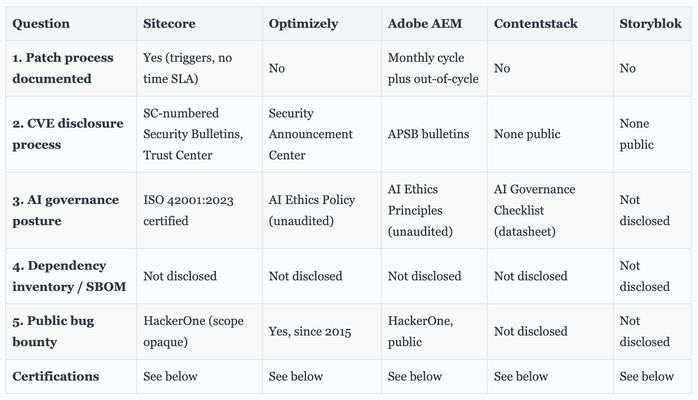
Nobody comes out spotless. That is the point.
Question 1: Time to Patch
Sitecore does not publish a time-based SLA, but the SitecoreAI developer documentation names three concrete patch triggers for the SaaS tier: routine updates roughly a week after a new Microsoft Windows base image, Microsoft critical security fixes, and Sitecore security fixes. That is more operational detail than Optimizely, Contentstack or Storyblok currently share. The track record is also on the record: CVE-2025-53690 in Sitecore XP landed in the CISA Known Exploited Vulnerabilities catalog in September 2025 with active exploitation. Patches shipped, no public post-mortem on timing.
Optimizely describes mature processes on its Trust Center but commits to no public window between confirmed vulnerability and patch.
Adobe Experience Manager runs a monthly scheduled patch cycle with APSB-numbered bulletins (for example APSB26-74). Critical issues trigger out-of-cycle releases. For a procurement team that wants a predictable cadence to plan around, this is the cleanest answer in the set.
Contentstack documents ISO 27001:2022, SOC 2 Type II and twice-yearly VAPT, but no patch-time commitment.
Storyblok has no public patch SLA.
Four of five vendors describe process maturity in abstract terms. Only Adobe commits to a cadence a buyer can calendar.
Question 2: CVE and Disclosure
Sitecore publishes structured Security Bulletins through its Knowledge Base in the format SC[Year]-[Sequence]-[Article ID], for example Security Bulletin SC2019-002-312864. The format has been in use since at least 2016 and gets picked up by Tenable and other advisory services. Vulnerabilities can also go to securityvulnerability@sitecore.com, and the Trust Center on trust.sitecore.com (via Vanta) offers a Status by Product view. No acknowledgement window, no safe-harbor language, but a working bulletin infrastructure.
Optimizely runs a Security Announcement Center on its support portal. Less broadly indexed than Adobe or Sitecore, but functional and consistent.
Adobe operates the most mature disclosure pipeline in the set. APSB bulletins, CVSS scores, HackerOne program, 1 business day first response and 2 business days to triage.
Contentstack has no public vulnerability disclosure process on its Trust Center.
Storyblok has no public vulnerability disclosure process.
Three vendors, three disclosure styles, from Adobe’s full APSB machinery to Sitecore’s SC bulletins to Optimizely’s announcement center. Two vendors have no public pipeline at all.
Question 3: AI Governance
Two sub-questions. Is there a framework for AI risks and controls? Is there documented AI-assisted hardening of the platform core?
On the first, four of five vendors say something in public. The levels of formality differ a lot.
Sitecore holds ISO/IEC 42001:2023, the international standard for Artificial Intelligence Management Systems, awarded in August 2026. Third-party audited. A procurement team can cite the certificate in a risk assessment.
Optimizely publishes an AI Ethics Policy on its Trust Center. Unilateral commitment, no audit.
Adobe published its AI Ethics Principles back in 2021. Also unilateral.
Contentstack publishes an AI Governance Checklist as a customer-facing datasheet. It is a marketing resource that describes how Contentstack helps you with governance, not a framework the vendor itself is audited against.
Storyblok has nothing public on AI governance at the time of this research.
An audited certificate is a different artifact than a published policy. For an architect building a risk assessment, a certificate carries external attestation. A principles document requires additional evidence to earn equivalent weight.
On the second sub-question, nobody says anything in public. None of the five vendors describes AI-assisted hardening against its platform core, in the sense that is operationally normal at Microsoft, Google and AWS. That absence is probably not evidence that no work is being done. It is evidence that the vendors do not yet treat it as a procurement signal. Expect that to change in the next 24 months.
Question 4: Dependencies and SBOM
A Sitecore install runs on .NET with dozens of NuGet dependencies. Optimizely CMS 13 is .NET Core with its own dependency tree. AEM is Java with Sling and Felix and OSGi. Contentstack and Storyblok have Node.js and other open-source stacks in their backend services. All five vendors ship substantial open-source attack surface.
None of the five publishes a Software Bill of Materials for the enterprise versions of their products. None commits publicly to a response time for CVEs in third-party dependencies.
Log4Shell in 2021 taught the market that this gap matters. Many buyers discovered they had Log4j in their stack through commercial products, not through their own code. Four years later, no DXP vendor in this set has fixed the public SBOM question. That is a market-level finding. Push on it in every RFI regardless of which vendor you are talking to.
Question 5: Bug Bounty
Optimizely has the most transparent story. Its bug bounty program launched in February 2015, with payouts of at least $5,000 for High-severity bugs and 85+ legitimate findings in the first 14 months. Reward structures have been publicly communicated.
Adobe runs a public HackerOne program. AEM-specific scope needs to be confirmed on the HackerOne page itself.
Sitecore works with HackerOne. The Trust Center mentions that rewards may apply depending on scope and severity. Scope and reward structures are not public.
Contentstack and Storyblok have no public bug bounty programs at the time of this research.
Bug bounty programs are not a complete picture of a vendor’s security posture. Their absence combined with a thin disclosure process is a weak signal, though. A vendor relying only on internal testing and private pentests has less external validation feeding its development lifecycle.
Certifications in Detail
The compliance picture across these five vendors is more differentiated than a „SOC 2 and ISO 27001“ shorthand suggests.
Sitecore: ISO/IEC 27001 (ISMS), ISO/IEC 27017:2015 (cloud controls), ISO/IEC 27018:2019 (PII in public cloud), ISO/IEC 42001:2023 (AI management system, August 2026). TISAX, with reference customers including Aston Martin and Triumph in the public account list. HIPAA compliant across the SaaS DXP products. DORA FAQ for EU financial services buyers under the Digital Operational Resilience Act in force since January 2025.
Optimizely: ISO/IEC 27001:2022, 27017:2015, 27018:2019. SOC 2 Type 2. PCI DSS v4.0.1. TISAX. CSA Level 1 CAIQ 4.0. HIPAA via BAAs for CMS and Web/Feature Experimentation specifically.
Adobe Experience Manager (Experience Cloud): SOC 2 Type 2, SOC 3, ISO 9001:2015, ISO 27001:2022, 27017:2015, 27018:2019, ISO 22301:2019, CSA STAR Level 2, HIPAA ready, GLBA ready, FERPA ready, TrustArc GDPR and APEC. AEM Managed Services adds FedRAMP Moderate for AEM Gov Cloud, PCI DSS 4.0 for the Enhanced Security Offering, ENS High in Spain, IRAP Protected in Australia Gov Cloud. TISAX is Adobe-wide but limited to the San Jose and Dublin offices, which affects how it applies to specific delivery contexts.
Contentstack: ISO 27001:2022, SOC 2 Type II. HIPAA described as „safeguards that support HIPAA compliance“ rather than a certification.
Storyblok: ISO 27001 certified. OWASP secure coding adherence as a framework reference. GDPR as regulation compliance. The public enterprise security page does not list SOC 2, HIPAA, PCI DSS, TISAX, FedRAMP or CSA STAR at the time of research.
Four observations from this.
HIPAA is not a single bar. Sitecore claims full HIPAA compliance across its SaaS DXP products. Optimizely offers HIPAA via BAAs for two specific products. Adobe calls AEM „HIPAA ready“ and explicitly places the compliance burden on the customer. Contentstack says „safeguards support HIPAA.“ Storyblok does not list HIPAA at all. For a healthcare buyer, these are four different procurement positions. Reading them as equivalent HIPAA entries in a matrix is the kind of mistake that gets caught in a security audit two years into the contract.
Sitecore and Optimizely both carry TISAX. For an automotive buyer in DACH with Aston Martin, Porsche, VW or BMW in the account list, TISAX is the baseline. Adobe’s TISAX scope covers offices, not products, which is a different compliance posture.
Adobe is the only vendor in this set with FedRAMP Moderate authorization. For U.S. federal buyers and government-adjacent enterprises, that is a one-of-one answer.
Sitecore’s ISO 42001 is the first AI-specific management system certification in the DXP space. Adobe, Optimizely and Contentstack have unilateral AI ethics or governance statements, which are useful but not externally audited. The gap between a certificate and a policy matters when you need to cite external attestation in a risk assessment.
Certifications are necessary but not sufficient. They say a vendor has process documentation and audit readiness. They do not say how fast the vendor patches, how structured the disclosure is, or how open the vendor is to external security research. The five questions sit downstream of the certifications and reveal different information.
Where Each Vendor Lands
Each top vendor leads on a different dimension.
Adobe leads on breadth of certification portfolio (FedRAMP, PCI DSS, IRAP, ENS High), public bounty transparency and monthly patch cadence.
Sitecore leads on AI governance (the only ISO 42001 certification in the set), structured CVE bulletins, full HIPAA compliance across its SaaS DXP and automotive positioning via TISAX with named reference customers.
Optimizely leads on cross-industry certification breadth (PCI DSS plus TISAX plus HIPAA via BAA for specific products), openly published bounty history and compliance for regulated commerce workloads.
Contentstack and Storyblok sit a tier below on operational security disclosure. Both hold ISO 27001, both market strong trust narratives, but neither publishes a structured CVE bulletin series, neither runs a public bug bounty, and neither has an AI governance position I can cite in a risk assessment.
No vendor leads on all five questions. The differences point to where each has put its investment, which is itself procurement information.
What to Do With This
Three practical adjustments to a typical DXP procurement.
Add the five questions to the RFI. Make them explicit. Require written answers. A vendor that cannot answer in writing within the RFI window is a vendor that will struggle to answer during a Sunday-night incident.
Weight the quality of documentation itself. An audited certificate is a different artifact than a published policy. A structured bulletin series is a different artifact than an email intake. These differences change what you can cite in a procurement document, and they change how fast the vendor can respond when a researcher finds something.
Separate certification from operational maturity. ISO 27001 and SOC 2 are table stakes in 2026. They tell you a vendor has processes. The five questions above tell you how those processes behave.
One More Thing
I will update this matrix. If you work at a vendor I covered and your Trust Center answers something I missed, send me the link and I will fix it. If you work at Acquia, Hygraph or Kentico, the same offer applies and I will cover you in a follow-up piece.
For buyers reading this: use the five questions in your next DXP RFI. If a vendor you had already shortlisted struggles to answer them, you have learned something important before signing the contract instead of two years in.
Methodology note: Research completed between 28 and 29 October 2026, based on publicly available documentation. Vendor policies change. If you are using this article as part of a live procurement, verify current state against each vendor’s live documentation.
Sources:
- Sitecore Security Programs page
- Sitecore Trust Center
- Sitecore Privacy and Security
- Sitecore Compliance programs and certifications
- SitecoreAI documentation on patching
- Example Sitecore Security Bulletin (SC2019-002)
- Sitecore ISO 42001 press release (August 2026)
- Optimizely Trust Center Compliance
- Optimizely AI Ethics Policy
- Optimizely Security Bug Bounty announcement
- Optimizely Security Announcement Center
- Adobe Compliance Certifications List
- Adobe Bug Bounty Program
- Adobe AI Ethics Principles
- Adobe Experience Manager Security Bulletins
- Contentstack Trust Center
- Contentstack AI Governance Checklist
- Storyblok Enterprise Security
- CISA KEV coverage of CVE-2025-53690 (Sitecore)
Ursprünglich veröffentlicht auf LinkedIn.